Archive for July, 2014
Sometimes zeroes don’t mean much…
Posted by alifeofknuckleballs in (Baseball) Life Ain't Fair..., Blue Jays Baseball, Dodgers Baseball, Impressive Debuts, Indians Baseball, Low-hit Gems on July 12, 2014
Dan Johnson, called up by the Blue Jays from Triple-A Buffalo on July 11, made his Toronto debut that same night against his old team, the Tampa Bay Rays, and had the most interesting stat line in his new club’s 8-5 victory.
Johnson, probably best known for his ninth-inning homer for Tampa Bay against the Red Sox in September of 2008 in a contest which gave the Rays the AL East lead and then another dinger against the Yankees in the 2011 season finale to help the Rays clinch the wild card, posted the following line in his Toronto debut:
0 AB, 3 R, 0 H, 0 RBI, 4 BB, 0 SO.
Though Johnson couldn’t get a hit, he still made a huge contribution for Toronto. The Blue Jays’ newest DH was still was able to reach base in all four plate appearances and, more importantly, came around to score three times – including the tie-breaking run in the ninth inning after he had drawn a leadoff walk against the struggling Grant Balfour.
Definitely an odd and crooked-looking line score.
This reminds me of a couple of weird-looking stat lines for Tom Candiotti, where he lost a couple of games despite allowing zero earned runs. Same with John Smoltz, who lost a pivotal game to the Philadelphia Phillies in Game Four of the 1993 NLCS.
Let’s start with the Smoltz game, with the Atlanta right-hander owning a career postseason record of 5-0 with a 2.13 ERA in nine starts heading into the October 10, 1993 contest against lefty Danny Jackson (a playoff veteran himself) and the Phillies. Thanks to a Mark Lemke error at second base in the fourth inning, the Phillies scored two runs off Smoltz to take a 2-1 lead. The Braves almost tied it in the eighth when they put two runners on with two outs and erratic closer Mitch “The Wild Thing” Williams took over for Jackson.
Lemke, looking to redeem himself for the earlier fielding error, took Williams’s second pitch to deep left – which would have tied the game but leftfielder Milt Thompson made a circus catch to end the inning.
Atlanta then put two runners on to lead off the ninth but Williams fielded Jeff Blauser’s sacrifice bunt attempt and threw out the lead runner at third base, before inducing Ron Gant – arguably the league’s best clutch hitter down the stretch – to hit into a game-ending double play. The Phillies won 2-1 to even the series at 2-2, and then won the next two games to clinch the NL pennant.
But here was Smoltz’s line in the game:
6.1 IP, 8 H, 2 R, 0 ER, 5 BB, 10 SO.
It was Smoltz’s first career postseason loss – despite the fact he struck out 10 Phillies and gave up zero earned runs. What was interesting too, was that reliever Mark Wohlers walked three and struck out five in two hitless innings, meaning Atlanta pitching struck out 15 Philadelphia hitters but the Phillies still prevailed [1].
 Then, on to Tom Candiotti. On August 3, 1990, the Cleveland Indians knuckleballer took a no-hitter into the bottom of the eighth inning at Yankee Stadium. He retired the first two batters and was four outs away from history, with a 4-2 lead. The Yankees had scored two runs in the first inning on a hit batsman, an error by second baseman Jerry Browne, a Candiotti wild pitch, and an RBI groundout by Mel Hall.
With two outs in the eighth, Steve Sax walked before Jim Leyritz reached on an error by shortstop Felix Fermin. Yankees rookie Oscar Azocar, in his first month in the majors, broke up the no-hitter with a single up the middle, cutting the deficit to 4-3.
At that juncture, Indians skipper John McNamara pulled Candiotti in favor of closer Doug Jones, who gave up a first-pitch home run to Hall, turning the 4-3 lead into a 6-4 deficit. That was the way the game ended, with Candiotti charged with the loss and the following line:
7.2 IP, 1 H, 5 R, 0 ER, 2 BB, 7 SO.
All five runs off Candiotti were unearned because of the fielding errors by Browne and Fermin.
Then on June 30, 1995, Candiotti was pitching for the Dodgers against the Colorado Rockies, and gave up two first-inning runs because of an error by third baseman Tim Wallach. At the time, the two runs seemed insignificant because Rockies starter Kevin Ritz was just 11-24 with a 5.78 ERA going into the season, and you would figure a lineup featuring Mike Piazza, Eric Karros, and Raul Mondesi would do some damage against a mediocre pitcher.
Unfortunately, the Dodgers couldn’t touch Ritz, who gave up just three hits over six shutout innings (though he also walked five and struck out only one). Karros finally homered off Curtis Leskanic in the ninth to break the shutout, but the Dodgers couldn’t get the tying run home in the 2-1 loss.
The line for Candiotti:
7 IP, 4 H, 2 R, 0 ER, 2 BB, 7 SO.
It was as good a start as Candiotti had had at Yankee Stadium five years earlier – but again only good enough for a loss. It would be that type of a season for the knuckleballer, who went 7-14 despite a respectable 3.50 ERA for a first-place Dodger team [2].
Funny stat lines – they happen in baseball from time to time, and thanks to Dan Johnson for reminding me of these couple of examples.
—————————————————————————————–
[1] Kent Mercker, who also appeared in the game for the Braves, recorded two outs but did not issue a walk or notch a strikeout.
[2] Teammate Ramon Martinez was 17-7 with a 3.66 ERA.
You’re not an All-Star!
Posted by alifeofknuckleballs in (Baseball) Life Ain't Fair..., Blue Jays Baseball, Indians Baseball, Knuckleballs on July 8, 2014
Right-hander Jeff Samardzija, traded from the Chicago Cubs to the Oakland Athletics on July 5, was named to the National League All-Star team the following afternoon for the upcoming Midsummer Classic at Minnesota’s Target Field.
Samardzija, who was 2-7 for the Cubs despite a 2.83 ERA in 17 starts (and 103 strikeouts in 108 innings), will be allowed to take part in the festivities but will not be pitching in the All-Star Game because of the trade which sent him from the NL to the AL.
But hey, at least he became an All-Star for the first time. Some players never got a chance to even be named to the All-Star Game. Some 20 years ago, a guy with a good ERA but a low win total wouldn’t have been named to the team.
Take Tom Candiotti, for instance, who was probably denied a shot at the 1991 Midsummer Classic because he was traded from the Cleveland Indians to the Toronto Blue Jays 10 days prior to the game. He also was unfortunate in that he pitched in the wrong era.
* * * * *
SkyDome played host to the 1991 All-Star Game and the Blue Jays had three All-Stars – rightfielder Joe Carter, second baseman Roberto Alomar, and left-handed starter Jimmy Key. The Indians, meanwhile, had only one representative for the Midsummer Classic. Second-year catcher Sandy Alomar Jr., despite having a bad year – he’d spent time on the disabled list and was hitting .200 going into July, was voted into the starting lineup by the fans. A .476 hitting tear the first seven days of July – including a 4-for-4 performance in the final game before the All-Star break – helped pushed his average up to a more respectable .241 at the end of the first half.
“Sandy Alomar was an All-Star with Cleveland,” Candiotti laughed as he told me this back in 2010. “He was voted in, but other than Sandy, there weren’t any other All-Star-caliber players on that team. The trade to Toronto – which happened before the break – might have cost me a spot on the All-Star team that year, because the Indians really had no other guys that were going to make it.” [1]
Nowadays, it seems to be a lot easier to make an All-Star roster. Take a look at the 2010 AL roster, for instance; there were a total of 42 All-Stars on that squad! Back in 1991, however, there were only 28 roster spots available on All-Star teams, which certainly cost Candiotti a spot. As the years went by, spots were added as the roster size went over the 30-man mark, so in the 2000s, there are far more players per club in the Midsummer Classic. In 2009, All-Star rosters increased from 32 to 33 players, but even that wasn’t enough.
In 2010, All-Star rosters were increased to 34 players, and a new rule was added: Pitchers who start on the Sunday before the break are prohibited from playing in the Midsummer Classic. Thus, that year, American League All-Star pitchers CC Sabathia and Trevor Cahill – who were named to the All-Star team earlier but each then started his team’s final game before the break – were part of the festivities at Angel Stadium, but weren’t eligible to pitch. [2]
That meant Joe Girardi, the manager of the AL squad, had to pick two more pitchers to replace them. In fact, Girardi added three – Jered Weaver, Justin Verlander, and Andrew Bailey – to the team. Reason? Girardi had originally picked Weaver as one of the replacements, not realizing the right-hander had pitched on Sunday. Thus, a replacement then had to be chosen for Weaver, opening up yet another spot on the AL team. [3]
So, in the end, Verlander replaced Sabathia, Weaver replaced Cahill, and finally, Bailey replaced Weaver.
Thanks to the new rule, Verlander and Bailey were recognized as All-Stars. Ditto Sabathia, Cahill, and Weaver, even though there were not part of the Midsummer Classic roster. A whopping total of 42 players – among them 18 pitchers – were recognized as All-Stars on the AL squad that year, including all the players who either were ineligible to pitch or couldn’t play because of an injury.
In 2011, it was more of the same. In total, four starting pitchers in the AL and two in the NL were declared ineligible to participate in the All-Star Game because they pitched on the Sunday before the break, meaning they needed to be replaced. And even then, there were some complications. Sabathia replaced Tampa Bay’s James Shields on the roster because Shields was starting on the final Sunday. Red Sox pitcher Jon Lester replaced Mariners pitcher Felix Hernandez because he also started on Sunday. But Sabathia just happened to pitch on Sunday too, meaning he was essentially a replacement needing his own replacement (which turned out to be Alexi Ogando of Texas). Lester happened to be on the disabled list, meaning he needed a replacement too (Ricky Romero of Toronto). So, the week after the initial announcement of the All-Star rosters, there were still players being added, and replacements needing to be replaced.
“If they had that rule when I was playing,” Candiotti shrugged, “I definitely would have made it one of those years. But I’m sure even with [roster sizes] increasing every year, there’ll always be complaints about how so-and-so was left off the team.”
That last part is probably right. Despite the new rule regarding pitchers and the increase in the roster size, there is still controversy over the player selection process. In fact, there has been for years, before and after the expanded rosters in the 2000s. In 2006, Kansas City pitcher Mark Redman was an All-Star despite an ERA of 5.27 and a 6-4 record at the break. Why was he an All-Star? Well, the rules state that each team has to have at least one representative on its league’s All-Star roster. In Redman’s case, he was the Royals’ lone representative, a year after going 5-15 in Pittsburgh. Speaking of the Pirates, they had their own controversial All-Star in 2003, when closer Mike Williams was selected for the Midsummer Classic as Pittsburgh’s lone representative despite his 6.44 ERA. That rule – where each major-league team needed at least one representative – was one that Candiotti also had to deal with when he was still pitching in the big leagues. Candiotti certainly missed out in 1991 because of that rule.
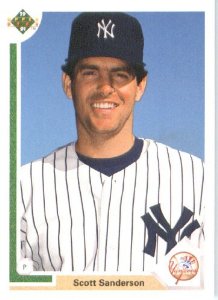 For instance, the ’91 Yankees were a fourth-place outfit in the AL East that didn’t deserve to have any players representing them in the Midsummer Classic. The Yankees, in fact, didn’t have any players voted in. However, since each team had to send at least one player, right-handed pitcher Scott Sanderson, 9-3 with a 3.93 ERA, was selected for the American League squad as the Yankees’ lone representative. While Sanderson’s won-loss record was great, he was far from being a dominant pitcher, averaging just over six innings per start with opponents hitting .276 against him. The knuckleballing Candiotti, on the other hand, was averaging over seven innings – 121.1 innings pitched over 17 starts – while posting a 2.23 ERA. Opponents were hitting only .224 off Candiotti. Thus, with Sanderson’s inclusion (which turned out to be the only time in his career he was an All-Star), a far more deserving pitcher like Candiotti was not selected. If there was no rule insisting each team had to have at least one player chosen as an All-Star, it’s very likely Candiotti’s 2.23 ERA – not to mention all the other stats except for walks – would have put him ahead of a pitcher with an ERA approaching 4.00.
First-half stats in 1991:
……………………………..GS IP H R ER BB SO HR ERA (W-L)
Candiotti (CLE/TOR)……. 17 121.1 102 38 30 33 96 7 2.23 (8-7)
Sanderson (NYY)……….. 17 103.0 112 48 45 13 60 9 3.93 (9-3)
“My numbers were up there some years,” Candiotti recalled, referring especially to 1990 and 1991. “My ERA was the [third-best] in the American League the year I was traded to Toronto. How do you have a pitcher with [one of the best ERAs] not make the team?”
He does offer up another explanation, however. It goes back to when Boston Red Sox catcher Rich Gedman had trouble handling Texas knuckleball pitcher Charlie Hough in the Midsummer Classic in 1986.
“Managers and coaches pick the pitchers for the All-Star team. Back in 1986, Charlie was on the American League team. He was pitching to Rich Gedman, the All-Star catcher that year. Gedman missed the ball and couldn’t catch it in that one inning Charlie was pitching.”
Hough struck out three straight batters in the eighth inning, but gave up two runs and couldn’t get out of the inning. With a runner on second base, Hough struck out Chili Davis for the first out, but the ball got past Gedman for a wild pitch. Hough then struck out Hubie Brooks, but the ball again got away – this time Gedman was charged with a passed ball – allowing the runner to score and Brooks to get to first base. Hough fanned Tim Raines for the second out before Steve Sax hit an RBI single to knock the knuckleball pitcher out of the game.
“A catcher just couldn’t catch a knuckleball pitcher if he wasn’t his personal catcher. A knuckleball pitcher really needs his own personal catcher, and so over the years after that, managers and his coaches weren’t going to pick a knuckleball pitcher.
“There were three years when I really deserved to go. One of those years was definitely 1991. Unfortunately for me, I was having a tremendous season, [third in] the American League in ERA [at the All-Star break]. Then I was traded to Toronto, and I was no longer a member of the Indians. There was nobody that really did anything on that Cleveland team that year. When I got to Toronto, there was Robbie Alomar, Joe Carter, Jimmy Key, Tom Henke, tons of guys, five or six players that could be picked as All-Stars. I was [third in] the league in ERA [at 2.23] but I didn’t get a chance to go. There was no doubt I would have been an All-Star [had I still been] with the Indians. But I was traded. Oh well.”
That’s right, oh well. So Jeff Samardzija – unless the rules are changed for him – won’t pitch in the 2014 Midsummer Classic. But hey, at least he was named to the National League squad. Some people just aren’t – or weren’t – lucky enough.
————————————————————————————
[1] The Indians apparently had no other guys that could make the All-Star team in 2010. Right-handed starting pitcher Fausto Carmona was the Indians’ lone representative at the Midsummer Classic, despite posting unspectacular numbers. At the break, Carmona was only 8-7 with a 3.64 ERA in 18 starts. By season’s end, the numbers would be 13-14 and 3.77. Those are numbers for an All-Star? And it wasn’t as though he made the team based on a great 2009 season, as he was 5-12 with a 6.32 ERA in 24 starts in ’09.
[2] “Rangers Righty Alexi Ogando Joins AL All-Stars,” Associated Press/Yahoo! Sports, July 10, 2011. In the 2011 season, almost the same thing happened with Sabathia. This time, CC wasn’t named to the All-Star team originally but was later added to the team as the replacement for Tampa Bay pitcher James Shields. However, Sabathia and Shields both pitched in the Yankees-Rays contest on the Sunday before the All-Star break, making them ineligible for the game. Thus, Texas pitcher Alexi Ogando was named to the AL squad as a replacement for Sabathia.
[3] “Verlander, Weaver, Bailey Added as AL All-Stars,” Associated Press/Yahoo! Sports, July 11, 2010.
Thanks for your services…but down you go to Triple-A!
Posted by alifeofknuckleballs in (Baseball) Life Ain't Fair..., Athletics Baseball on July 7, 2014
Left-hander Tommy Milone, who as recently as two weeks ago was thought of as “Mr. Reliable” of the Oakland A’s pitching staff, was sent to Triple-A Sacramento on July 5 to make room for right-hander Jeff Samardzija, who along with righty Jason Hammel had just been acquired in a trade from the Chicago Cubs.
The 27-year-old Milone was 6-3 with a 3.55 ERA in 16 starts this season for the A’s, and had tossed six shutout innings the day before in Oakland’s 1-0 win over the Blue Jays. Since beginning the season 0-3, the lefty had gone 6-0 with a 2.62 ERA with the A’s going 9-2 in those starts.
It is expected Milone would be back at some point later in the season, but this reminds me of another stunning demotion in Oakland which took place 15 years ago.
Back in 1999, going into the season the A’s starting pitching was led by veteran lefty Kenny Rogers and knuckleballer Tom Candiotti, but beyond those top two spots Oakland seemed very thin in that department.
Jimmy Haynes (5.09 ERA in 1998), Gil Heredia (22-24 lifetime and only 45 career starts), and Brad Rigby (5-6 with a 5.94 ERA in Triple-A Edmonton and injured most of 1998) were expected to be the Nos. 3, 4, 5 starters, respectively.
Mike Oquist, 11-17 with a 5.76 ERA in 1997-98 with the A’s, had been reassigned to minor-league camp to start the season.
With Haynes, Heredia, Rigby, and Oquist not having a lot of big-league experience and with Rogers expected to be traded once the A’s fell out of contention, Candiotti was looked upon to pick up the staff.
 Unfortunately, Candiotti wouldn’t be the innings-eater the A’s were hoping for in 1999 – and it ultimately affected Rigby the most because he had to make emergency relief appearances when Candiotti came out of ballgames early.
What happened was Rigby went on to lose his spot in the Oakland rotation permanently – thanks to Candiotti.
The trouble started on April 11 in Seattle, when Candiotti ripped a fingernail while warming up before his start against the Mariners. Because of the torn nail, he couldn’t throw the knuckleball and had to rely on his fastballs. The Mariners, delighted at seeing the mediocre fastballs that the 40-year-old Candiotti was serving up, ripped him for six runs on seven hits in his 2.1 innings of work in their 11-8 victory.
Because of Candiott’s ineffectiveness and early exit, Rigby – the scheduled starter for the A’s game against Anaheim two nights later – had to come in and pitch in relief of the knuckleballer in order to save the rest of the bullpen. Rigby was pounded for four runs on seven hits in 1.2 innings, and not only was he deprived of his starting assignment against the Angels, he would also be sent to the minors the following day, losing his fifth-starter spot (and major-league roster spot) to Mike Oquist!
Rigby, who had beaten out Oquist as the A’s No. 5 starter in spring training, would be back with Oakland soon enough – he was recalled a week and a half later – but would be pitching exclusively out of the bullpen as a long reliever.
Meanwhile, the Seattle game wouldn’t be the last time that Candiotti put Rigby in a bad spot. Two weeks later, when he had to leave a start in the first inning against Cleveland, Rigby again came in and was ripped for five runs in 5.1 innings. But at least Rigby was able to save the bullpen by pitching deep into the game in relief.
Small consolation, of course, for the man who was supposed to be the A’s fifth starter in 1999. If only he hadn’t volunteered to give the team a few innings to help save the bullpen against the Mariners…
“A couple of days ago, they tell me I’m starting [against the Angels],” Rigby said the day manager Art Howe informed him he was being sent down to Triple-A. “Then I go and throw in the bullpen. Do my arm and shoulder exercises. I ice. I’m in the dugout, ready to watch the game.
“Then the starter [Candiotti] goes down [against the Mariners], and they need a guy to go out there and suck up some innings. I tell them I can pitch. And I go out and pitch. And this [demotion to the minors] happens today. I’m upset. This isn’t right. I went out there and did something for the team.” [1]
As it turned out, Brad Rigby would not start another game in the majors, and would be traded on July 31 with two other pitchers to the Royals for Kevin Appier. Rigby, who had gone 1-7 in 14 starts for Oakland in 1997, would go 4-6 with a 6.01 ERA in 59 relief appearances in 1999-2000, and would appear in his final big-league game with the Montreal Expos on June 24, 2000.
All this after he had easily won the competition for the fifth starter spot in the A’s rotation. [2]
As for Mike Oquist, he started – and won – his game against the Angels, beating knuckleballer Steve Sparks, 3-2. So, that means Oquist had two knuckleball pitchers to thank for his victory; Candiotti for his early exit making Rigby unavailable to pitch and getting him called up, and then Oquist himself throwing well enough in out-pitching the knuckleballing Sparks.
“There’s always some kind of story, the way these things happen,” Oquist would say later. [3]
Well, try telling that to Rigby. And to Tommy Milone in 2014.
But even that’s not the end of the story. Mike Oquist, who had the second-highest ERA (6.22) in the American League in 1998, would be done following the ’99 season at the age of 31. He went 9-10 with a 5.37 ERA that year and never pitched in the big leagues again, instead toiling in Triple-A Toledo for the Tigers organization in 2000 and losing 15 games.
—————————————————————————————————————–
[1] Frank Blackman, “A Funny Way to Thank Rigby,” San Francisco Examiner, April 13, 1999.
[2] Ibid.
[3] Mark Fainaru-Wada, “Luck Helps Oquist Nail Down Win,” San Francisco Examiner, April 14, 1999.
Dominant streaks: Clemens, Johnson, Pedro… and who?
Posted by alifeofknuckleballs in Dodgers Baseball, Low-hit Gems on July 5, 2014
Back on June 29, Seattle Mariners ace right-hander Felix Hernandez allowed only one hit over eight shutout innings to defeat the visiting Cleveland Indians 3-0, giving up just Lonnie Chisenhall’s fifth-inning single.
For Hernandez, who walked three, it was his ninth consecutive start where he had pitched at least seven innings while giving up two runs or fewer. During that stretch, Hernandez was 6-1 with a 1.30 ERA with 77 strikeouts and just 10 walks over 69 innings. In those nine outings, he surrendered a total of 42 hits and one homer.
The nine consecutive starts with seven or more innings with two or fewer runs is a Mariners club record, and in fact is a rare feat in baseball. According to Baseball-Reference.com, Tom Seaver holds the longest such streak in big-league history, going 13 straight starts in 1971 where he allowed two runs or fewer while working at least seven innings.
From 2001-2013, only six pitchers had such a streak of at least eight consecutive starts, which shows how rare Hernandez’s feat has been.
 As for the 1990s? Well, only five pitchers in that decade had a stretch of eight straight starts where they gave up only two runs or fewer while pitching at least seven innings. The list includes fireballers Roger Clemens, Randy Johnson, and Pedro Martinez. You would expect to see those names, as Clemens, Johnson, and Martinez were three of the most dominant pitchers in the 1990s, as well as in baseball history. Surprisingly, Ed Whitson accomplished this feat during the 1990 season, when he went 5-0 with a 0.99 ERA in those eight consecutive starts from July 25 to September 2 for the San Diego Padres. During his streak, Whitson walked just eight batters in 63.1 innings.
Who was the fifth pitcher to accomplish that rare feat in the 1990s with eight consecutive such starts? No, not Greg Maddux [1]. Not Tom Glavine or John Smoltz. Not Mike Mussina.
Nope. The fifth guy who did it was Los Angeles Dodgers knuckleballer Tom Candiotti, who accomplished the feat in 1993.
During a season which saw the Dodgers finish 81-81, the highlights were rookie Mike Piazza’s monster season and the team’s 12-1 rout over the Giants on the final day of the year to knock San Francisco out of the postseason.
But there was also the overlooked Candiotti and his pitching throughout the summer, as he had a 1.85 ERA in 22 starts from May 1 to the end of August. Entering play on September 1, Candiotti’s 2.43 ERA was the best in the major leagues, marking the second time in three years that he had the ERA lead at one point in the final weeks of the season.
The knuckleballer’s streak of eight straight starts with two or fewer runs and seven or more innings took place from July 18 to August 25, when he pitched to a 1.32 ERA over 61.1 innings while allowing only 17 walks and four home runs. Included in that streak was a 2-1 win on July 28 in San Francisco, where he held Giants sluggers Will Clark, Matt Williams, and Barry Bonds to one hit in 10 at-bats.
Candiotti went only 5-0 in that streak because he didn’t get enough support in the other three starts. On August 9, he gave up two runs over eight frames but the Dodgers lost 3-2 in 11 innings against Colorado. (The Dodgers couldn’t touch Rockies right-hander Greg Harris, who would be 4-20 with a 6.60 ERA in a Colorado uniform in 1993-94.) On August 20 in St. Louis, Candiotti allowed two runs over seven innings but left the game trailing 2-0 against rookie Rene Arocha, before the Dodgers rallied for three runs in the ninth to spare him a heart-breaking loss. Five nights later, he gave up one run on four hits over eight innings against Pittsburgh, only to leave the game trailing 1-0 to Pirates rookie Paul Wagner. The Dodgers tied it in the bottom of the eighth but ultimately lost 2-1 in 12 innings.
That performance in that last outing on August 25 lowered Candiotti’s ERA to 2.43, tops in all of baseball.
Certainly, when you think about long stretches of dominant pitching, you think of guys such as Felix Hernandez, Roger Clemens, Randy Johnson, and Pedro Martinez. Ed Whitson? Well, at least he threw a fastball.
Tom Candiotti, a guy who threw a knuckleball? You would have never figured he had had such a long run of great pitching. But it happened. Back in that underrated 1993 season.
[1] Even in Maddux’s dominant 1994-95 seasons, when he had sub-2.00 ERAs of 1.56 and 1.63, respectively, he didn’t have that many starts in a row with seven or more innings with two or fewer runs allowed. The longest streak he had in those seasons lasted “only” a half-dozen. Maddux had six consecutive such starts in 1994, and again six straight in 1995.
And how do you score that one again?
Posted by alifeofknuckleballs in Impressive Debuts, Indians Baseball, Knuckleballs, Odd plays on July 4, 2014
On July 3, Minnesota’s Chris Parmelee extended his hitting streak to 13 games with a first-inning RBI double against Yankees rookie right-hander Masahiro Tanaka, but the Twins still went on to fall 7-4 to New York.
Parmelee, who is batting .440 during the streak and .286 on the year, was also tagged out on an unconventional 9-4-2-5-7 play when he tried to stretch his two-bagger but then stopped and tried to return to second base.
Sure, it was also a game which saw Tanaka (12-3) become the winningest Yankees rookie before the All-Star break, surpassing the 11 first-half victories collected by Spec Shea in 1947 (according to the Elias Sports Bureau), and fellow rookie Zelous Wheeler homered in his major-league debut after spending nearly eight years in the minors… but how often do you see a 9-4-2-5-7 play in a ballgame?
This reminds me of a strange play in an Indians-Royals game back on April 16, 1990, where an unusual 6-4-4-5 double play – with an assist to the umpire – took place on a rainy day in Kansas City.
Tom Candiotti was on the mound for Cleveland that afternoon, and though he often pitched in hard luck throughout his career, actually benefited this time – with help from this particular odd (and controversial) double play.
 There were two Royals runners on base – Jim Eisenreich on second and Kurt Stillwell on first – with nobody out in the second inning.
Because it was early in the game and Candiotti also couldn’t get a good grip of the knuckleball in the rain, the Indians ace wasn’t throwing his knuckler. With Candiotti tossing very hittable pitches, Willie Wilson hit a hard line drive that Indians shortstop Rafael Santana caught, but the ball dropped out of his glove. Second baseman Carlos Baerga picked the ball up, and stepped on the bag to force Stillwell out. But Baerga dropped the ball as well!
“This was a rainy afternoon in Kansas City,” Candiotti recalls years later, “and the field was wet, the ball was wet… everything was ugly out there.”
However, Baerga then alertly picked up the ball again and stepped on second base once more, beating Stillwell to the bag. For some reason, second-base umpire Rich Garcia missed the play and called Stillwell safe. And for some reason, Eisenreich was caught between second and third.
“Then Baerga saw Eisenreich, and threw to Brook Jacoby at third base,” recalls Candiotti. “They got the guy out. So, it looked like we got just that one out at third base, and there were still two runners on with one out.”
Third-base umpire Steve Palermo, however, overturned Garcia’s call and signaled Stillwell out, which was the correct play. So now there were two outs, and two pitches later Candiotti was out of the inning as he retired Frank White on a lineout to centerfield.
“It was a double play, but how do you score that?” asks Candiotti.
Simple: You score it Candiotti as the winner, as Cleveland went on to win 6-3 in the rain.
“Tom Candiotti: A Life of Knuckleballs,” a biography of former big-league pitcher Tom Candiotti, will be released in July of 2014. You may pick up a copy either from Amazon.com or through the McFarland & Company website.
-
You are currently browsing the archives for July, 2014
Buy from Amazon.com

Buy from Barnes & Noble

The 1988 Dodgers
Tom Candiotti: A Life of Knuckleballs

Flag Stats
 A Life of Knuckleballs