Archive for category Blue Jays Baseball
You’re not an All-Star!
Posted by alifeofknuckleballs in (Baseball) Life Ain't Fair..., Blue Jays Baseball, Indians Baseball, Knuckleballs on July 8, 2014
Right-hander Jeff Samardzija, traded from the Chicago Cubs to the Oakland Athletics on July 5, was named to the National League All-Star team the following afternoon for the upcoming Midsummer Classic at Minnesota’s Target Field.
Samardzija, who was 2-7 for the Cubs despite a 2.83 ERA in 17 starts (and 103 strikeouts in 108 innings), will be allowed to take part in the festivities but will not be pitching in the All-Star Game because of the trade which sent him from the NL to the AL.
But hey, at least he became an All-Star for the first time. Some players never got a chance to even be named to the All-Star Game. Some 20 years ago, a guy with a good ERA but a low win total wouldn’t have been named to the team.
Take Tom Candiotti, for instance, who was probably denied a shot at the 1991 Midsummer Classic because he was traded from the Cleveland Indians to the Toronto Blue Jays 10 days prior to the game. He also was unfortunate in that he pitched in the wrong era.
* * * * *
SkyDome played host to the 1991 All-Star Game and the Blue Jays had three All-Stars – rightfielder Joe Carter, second baseman Roberto Alomar, and left-handed starter Jimmy Key. The Indians, meanwhile, had only one representative for the Midsummer Classic. Second-year catcher Sandy Alomar Jr., despite having a bad year – he’d spent time on the disabled list and was hitting .200 going into July, was voted into the starting lineup by the fans. A .476 hitting tear the first seven days of July – including a 4-for-4 performance in the final game before the All-Star break – helped pushed his average up to a more respectable .241 at the end of the first half.
“Sandy Alomar was an All-Star with Cleveland,” Candiotti laughed as he told me this back in 2010. “He was voted in, but other than Sandy, there weren’t any other All-Star-caliber players on that team. The trade to Toronto – which happened before the break – might have cost me a spot on the All-Star team that year, because the Indians really had no other guys that were going to make it.” [1]
Nowadays, it seems to be a lot easier to make an All-Star roster. Take a look at the 2010 AL roster, for instance; there were a total of 42 All-Stars on that squad! Back in 1991, however, there were only 28 roster spots available on All-Star teams, which certainly cost Candiotti a spot. As the years went by, spots were added as the roster size went over the 30-man mark, so in the 2000s, there are far more players per club in the Midsummer Classic. In 2009, All-Star rosters increased from 32 to 33 players, but even that wasn’t enough.
In 2010, All-Star rosters were increased to 34 players, and a new rule was added: Pitchers who start on the Sunday before the break are prohibited from playing in the Midsummer Classic. Thus, that year, American League All-Star pitchers CC Sabathia and Trevor Cahill – who were named to the All-Star team earlier but each then started his team’s final game before the break – were part of the festivities at Angel Stadium, but weren’t eligible to pitch. [2]
That meant Joe Girardi, the manager of the AL squad, had to pick two more pitchers to replace them. In fact, Girardi added three – Jered Weaver, Justin Verlander, and Andrew Bailey – to the team. Reason? Girardi had originally picked Weaver as one of the replacements, not realizing the right-hander had pitched on Sunday. Thus, a replacement then had to be chosen for Weaver, opening up yet another spot on the AL team. [3]
So, in the end, Verlander replaced Sabathia, Weaver replaced Cahill, and finally, Bailey replaced Weaver.
Thanks to the new rule, Verlander and Bailey were recognized as All-Stars. Ditto Sabathia, Cahill, and Weaver, even though there were not part of the Midsummer Classic roster. A whopping total of 42 players – among them 18 pitchers – were recognized as All-Stars on the AL squad that year, including all the players who either were ineligible to pitch or couldn’t play because of an injury.
In 2011, it was more of the same. In total, four starting pitchers in the AL and two in the NL were declared ineligible to participate in the All-Star Game because they pitched on the Sunday before the break, meaning they needed to be replaced. And even then, there were some complications. Sabathia replaced Tampa Bay’s James Shields on the roster because Shields was starting on the final Sunday. Red Sox pitcher Jon Lester replaced Mariners pitcher Felix Hernandez because he also started on Sunday. But Sabathia just happened to pitch on Sunday too, meaning he was essentially a replacement needing his own replacement (which turned out to be Alexi Ogando of Texas). Lester happened to be on the disabled list, meaning he needed a replacement too (Ricky Romero of Toronto). So, the week after the initial announcement of the All-Star rosters, there were still players being added, and replacements needing to be replaced.
“If they had that rule when I was playing,” Candiotti shrugged, “I definitely would have made it one of those years. But I’m sure even with [roster sizes] increasing every year, there’ll always be complaints about how so-and-so was left off the team.”
That last part is probably right. Despite the new rule regarding pitchers and the increase in the roster size, there is still controversy over the player selection process. In fact, there has been for years, before and after the expanded rosters in the 2000s. In 2006, Kansas City pitcher Mark Redman was an All-Star despite an ERA of 5.27 and a 6-4 record at the break. Why was he an All-Star? Well, the rules state that each team has to have at least one representative on its league’s All-Star roster. In Redman’s case, he was the Royals’ lone representative, a year after going 5-15 in Pittsburgh. Speaking of the Pirates, they had their own controversial All-Star in 2003, when closer Mike Williams was selected for the Midsummer Classic as Pittsburgh’s lone representative despite his 6.44 ERA. That rule – where each major-league team needed at least one representative – was one that Candiotti also had to deal with when he was still pitching in the big leagues. Candiotti certainly missed out in 1991 because of that rule.
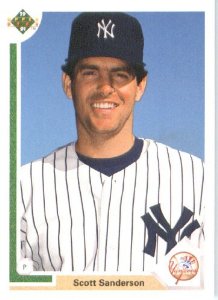 For instance, the ’91 Yankees were a fourth-place outfit in the AL East that didn’t deserve to have any players representing them in the Midsummer Classic. The Yankees, in fact, didn’t have any players voted in. However, since each team had to send at least one player, right-handed pitcher Scott Sanderson, 9-3 with a 3.93 ERA, was selected for the American League squad as the Yankees’ lone representative. While Sanderson’s won-loss record was great, he was far from being a dominant pitcher, averaging just over six innings per start with opponents hitting .276 against him. The knuckleballing Candiotti, on the other hand, was averaging over seven innings – 121.1 innings pitched over 17 starts – while posting a 2.23 ERA. Opponents were hitting only .224 off Candiotti. Thus, with Sanderson’s inclusion (which turned out to be the only time in his career he was an All-Star), a far more deserving pitcher like Candiotti was not selected. If there was no rule insisting each team had to have at least one player chosen as an All-Star, it’s very likely Candiotti’s 2.23 ERA – not to mention all the other stats except for walks – would have put him ahead of a pitcher with an ERA approaching 4.00.
First-half stats in 1991:
……………………………..GS IP H R ER BB SO HR ERA (W-L)
Candiotti (CLE/TOR)……. 17 121.1 102 38 30 33 96 7 2.23 (8-7)
Sanderson (NYY)……….. 17 103.0 112 48 45 13 60 9 3.93 (9-3)
“My numbers were up there some years,” Candiotti recalled, referring especially to 1990 and 1991. “My ERA was the [third-best] in the American League the year I was traded to Toronto. How do you have a pitcher with [one of the best ERAs] not make the team?”
He does offer up another explanation, however. It goes back to when Boston Red Sox catcher Rich Gedman had trouble handling Texas knuckleball pitcher Charlie Hough in the Midsummer Classic in 1986.
“Managers and coaches pick the pitchers for the All-Star team. Back in 1986, Charlie was on the American League team. He was pitching to Rich Gedman, the All-Star catcher that year. Gedman missed the ball and couldn’t catch it in that one inning Charlie was pitching.”
Hough struck out three straight batters in the eighth inning, but gave up two runs and couldn’t get out of the inning. With a runner on second base, Hough struck out Chili Davis for the first out, but the ball got past Gedman for a wild pitch. Hough then struck out Hubie Brooks, but the ball again got away – this time Gedman was charged with a passed ball – allowing the runner to score and Brooks to get to first base. Hough fanned Tim Raines for the second out before Steve Sax hit an RBI single to knock the knuckleball pitcher out of the game.
“A catcher just couldn’t catch a knuckleball pitcher if he wasn’t his personal catcher. A knuckleball pitcher really needs his own personal catcher, and so over the years after that, managers and his coaches weren’t going to pick a knuckleball pitcher.
“There were three years when I really deserved to go. One of those years was definitely 1991. Unfortunately for me, I was having a tremendous season, [third in] the American League in ERA [at the All-Star break]. Then I was traded to Toronto, and I was no longer a member of the Indians. There was nobody that really did anything on that Cleveland team that year. When I got to Toronto, there was Robbie Alomar, Joe Carter, Jimmy Key, Tom Henke, tons of guys, five or six players that could be picked as All-Stars. I was [third in] the league in ERA [at 2.23] but I didn’t get a chance to go. There was no doubt I would have been an All-Star [had I still been] with the Indians. But I was traded. Oh well.”
That’s right, oh well. So Jeff Samardzija – unless the rules are changed for him – won’t pitch in the 2014 Midsummer Classic. But hey, at least he was named to the National League squad. Some people just aren’t – or weren’t – lucky enough.
————————————————————————————
[1] The Indians apparently had no other guys that could make the All-Star team in 2010. Right-handed starting pitcher Fausto Carmona was the Indians’ lone representative at the Midsummer Classic, despite posting unspectacular numbers. At the break, Carmona was only 8-7 with a 3.64 ERA in 18 starts. By season’s end, the numbers would be 13-14 and 3.77. Those are numbers for an All-Star? And it wasn’t as though he made the team based on a great 2009 season, as he was 5-12 with a 6.32 ERA in 24 starts in ’09.
[2] “Rangers Righty Alexi Ogando Joins AL All-Stars,” Associated Press/Yahoo! Sports, July 10, 2011. In the 2011 season, almost the same thing happened with Sabathia. This time, CC wasn’t named to the All-Star team originally but was later added to the team as the replacement for Tampa Bay pitcher James Shields. However, Sabathia and Shields both pitched in the Yankees-Rays contest on the Sunday before the All-Star break, making them ineligible for the game. Thus, Texas pitcher Alexi Ogando was named to the AL squad as a replacement for Sabathia.
[3] “Verlander, Weaver, Bailey Added as AL All-Stars,” Associated Press/Yahoo! Sports, July 11, 2010.
Knuckleball long balls
Posted by alifeofknuckleballs in Blue Jays Baseball, Dodgers Baseball, Knuckleballs, Rare Baseball Videos on July 2, 2014
On June 27, Toronto knuckleballer R.A. Dickey gave up four home runs in a 5-4 loss to the visiting Chicago White Sox, falling to 6-7 with a 4.24 ERA this season.
A few things of note here: Dickey’s four dingers allowed gave him 10 surrendered over his last five starts, which accounted for 13 of the 14 runs against him in that span. The four homers by the White Sox – including two hit by rookie Jose Abreu, who’s now got 25 on the season and is more than halfway toward breaking Mark McGwire’s rookie record (49 set in 1987) – were the most Dickey had allowed since giving up six against Detroit on April 6, 2006. That game happened to be Dickey’s first big-league start as a knuckleballer.
Interestingly, in Tom Candiotti’s career, the most number of home runs he ever gave up in a game was three. In his first major-league start as a knuckleball pitcher in 1986 – in his first two seasons he wasn’t a knuckleballer – Candiotti gave up only one run, and that was a homer hit by Rick Dempsey. In fact, that home run was hit off of a Candiotti fastball; otherwise, he would have pitched scoreless ball that evening against the Orioles.
Also, June 27 was the anniversary of the Candiotti trade from Cleveland to Toronto in 1991. He finished with an undeserving 6-7 record with a 2.98 ERA as a Blue Jay. Dickey, of course, is 6-7 for Toronto right now with an ERA that is much higher.
One more point about the home runs: According to newspaper accounts during that 1991 season, almost none of the homers hit off Candiotti – he allowed only 12 in 238 innings – came off of the knuckleball. Nearly every one of them came on a curveball or fastball, in situations where he didn’t want to pitch around hitters, where he wanted to go right after the hitter with runners on base.
Among the homers Candiotti allowed in 1991, at least four of them came off of fastballs, with Joe Carter, Mike Greenwell, Kevin Maas, and Juan Gonzalez doing the honors. Robin Ventura hit a grand slam off of him on a slider (one of just three bases-loaded homers over 451 major-league games for Candiotti). Tom Brunansky and Carlos Martinez hit curveballs off of Candiotti out of the park as well. That would be a total of seven homers at least, coming off of something other than a knuckler.
The other home runs Candiotti gave up that season were not indicated in the newspaper recaps for those individual games.
Finally, here’s a neat video from 1993 featuring Candiotti pitching for the Dodgers in Taiwan:
“Tom Candiotti: A Life of Knuckleballs,” a biography of former big-league pitcher Tom Candiotti, will be released in July of 2014. You may pick up a copy either from Amazon.com or through the McFarland & Company website.
Seven shutout innings for the third consecutive start…
Posted by alifeofknuckleballs in Blue Jays Baseball, Knuckleballs, Low-hit Gems, Shutouts & Scoreless Streaks on June 18, 2014
While the two Detroit Cy Young winners – Justin Verlander and Max Scherzer – made headlines by getting lit up for 17 runs in the first two games of the Tigers’ series with Kansas City earlier this week, an unheralded pitcher in the same division has quietly put together a brilliant run without much fanfare [1].
On June 18, Minnesota’s Kyle Gibson tossed seven shutout innings for the third consecutive start, blanking the Boston Red Sox on only one hit at Fenway Park. Unfortunately for the Twins right-hander, who is in his second season in the majors, got a no-decision as Minnesota couldn’t score against Red Sox starter John Lackey, who allowed only three hits over nine shutout innings.
The Twins eventually lost 2-1 in 10 innings on back-to-back homers by David Ortiz and Mike Napoli.
Gibson retired the first 14 Red Sox batters before Daniel Nava stroked a fifth-inning double for the only Boston hit off of him. Back on June 7, the sophomore righty pitched three-hit ball in his seven innings of work to beat Houston 8-0. Six nights later, he won 2-0 in Detroit with a seven-inning five-hitter. Then in the Red Sox game, one hit over seven innings with no walks and eight strikeouts.
But that’s not all for the young right-hander, who now sports a 3.25 ERA. Back on May 28, he tossed six shutout innings of six-hit, no-walk ball against Texas but received a no-decision in the Twins’ 1-0 loss. In Minnesota’s 1-0 win at Cleveland on May 5, Gibson pitched seven innings of two-hit ball in another no-decision. He also blanked Toronto on a four-hitter over eight innings on April 17, winning 7-0. That’s six scoreless starts through his first 14 outings. In three other starts, he gave up exactly one run.
So, a fantastic season so far for Kyle Gibson, and three straight scoreless starts and counting.

Though Greg Myers had never caught a knuckleballer prior to Candiotti’s arrival in Toronto in 1991, he still handled the new Blue Jays knuckleball pitcher very well. In the eight games that the pair worked together, Candiotti notched a 0.91 ERA.
I do want to bring up Tom Candiotti’s 1991 season, where the knuckleball specialist had six scoreless starts and also seven outings where he allowed only one run. That’s 13 of his 34 starts where he gave up one run or none, not bad for a knuckleball pitcher.
Candiotti nearly had the same streak as Kyle Gibson, but it ended in the ninth inning on July 16, 1991 in Kansas City.
Candiotti had been traded from Cleveland to Toronto on June 27, and in his second start with the Blue Jays threw seven shutout innings against Minnesota on July 3 for a 4-0 win. On July 11, it was eight shutout innings in a 2-0 victory over Texas.
Then came July 16, where Candiotti took a 1-0 shutout in the bottom of the ninth inning against the Royals. So, if he came out of the game then, he would have had three straight scoreless starts. However, he was left in the game to try and complete the one-run shutout, and Kirk Gibson tripled before scoring on a passed ball by catcher Greg Myers. The Royals then got the winning run off Candiotti in the bottom of the 10th, thanks to a throwing error by Myers.
So, Candiotti was that close to getting a third straight scoreless game.
That wasn’t it for the knuckleballer. On September 18, he took a 1-0 lead into the bottom of the eighth in Seattle before the Mariners tied the game off of him on an Omar Vizquel triple followed by a Ken Griffey Jr. single. On September 7, Candiotti took a shutout into the ninth inning but gave up a home run to Carlos Martinez in the eventual 4-1 Blue Jays victory.
In eight of his first 16 starts with Toronto following the mid-season trade, he took a shutout into the eighth inning – that’s half of his outings with the Blue Jays!
With Kyle Gibson in 2014, six scoreless starts through his first 14 outings…perhaps he’ll add on to those numbers before the season is done.
[1] According to the June 17 game recap on ESPN, STATS noted that the 17 runs allowed by the two Tiger aces were the most ever by two teammates with Cy Young Awards in back-to-back team games. The Royals moved ahead of the Tigers atop the AL Central in the Scherzer game, and then defeated Detroit again the following afternoon by a 2-1 final in the third of their four-game set, ensuring that they would leave town in first place regardless of what happened in the series finale.
“Tom Candiotti: A Life of Knuckleballs,” a biography of former big-league pitcher Tom Candiotti, will be released in July of 2014. You may pick up a copy either from Amazon.com or through the McFarland & Company website.
Six innings of one-hit ball… Flashback to 23 years ago…
Posted by alifeofknuckleballs in Blue Jays Baseball, Impressive Debuts, Indians Baseball, Low-hit Gems on June 15, 2014
On June 14th, San Diego Padres rookie Jesse Hahn gave up just one hit – an infield single by Mets shortstop Ruben Tejada to lead off the bottom of the first – over six innings in only his second major-league appearance, winning a 5-0 decision over New York.
The right-handed Hahn, who was just called up from Double-A San Antonio to make the start, even contributed an RBI single as he picked up his first major-league win. He had made his big-league debut on June 3rd against Pittsburgh, allowing four runs on six hits – including two home runs – over 3.2 innings. Hahn was then optioned to Double-A the following day.
But with lefty Robbie Erlin on the disabled list since May 22nd and Tim Stauffer struggling while briefly being used in the rotation (a total of nine runs allowed over three innings in his last two starts), the Padres turned back to Hahn.
If the rookie right-hander can continue pitching the way he did in his second career start in the majors, he might stick around for a while. Doesn’t get much better than six innings and allowing just one hit in your second major-league start.
That reminds me of a game between Cleveland and Toronto 23 years ago – almost to the day. Back on June 12th, 1991, a rookie right-hander by the name of Mike Timlin made his first big-league start for the Blue Jays, facing Tom Candiotti and the Indians. Timlin had already appeared in 26 major-league games – and had notched four victories against three defeats – but was making his first start since Single-A ball in 1989. Used as a closer in the minors, Timlin had pitched to an unimpressive 3.92 ERA in his first two months in the majors.
And yet Timlin opened the game with three perfect innings before walking Alex Cole to lead off the fourth. He took a no-hitter in the sixth inning, before Felix Fermin broke it up with an infield single. That proved to be the only hit the Indians managed off Timlin in his six full innings of work.
Cleveland would get just one more hit after that, coming in the seventh off lefty Bob MacDonald – another rookie. Thanks to the Indians’ punchless offense, Candiotti was a hard-luck 1-0 loser despite throwing a complete-game three-hitter of his own [1].
Timlin, meanwhile, would appear in 1,054 major-league games as a reliever while making just four starts. In his second start six days after beating Candiotti, Timlin was roughed up for three runs on seven hits and two walks over 3.2 innings in a loss to the Yankees. Naturally, in his third major-league start on June 23rd, he tossed five shutout innings against Cleveland. The opposing pitcher that night? Once again, Tom Candiotti.
Timlin wouldn’t make another start until 2002 with the St. Louis Cardinals, when he allowed four runs over 4.1 innings in Milwaukee in what turned out to be his final starting assignment in the majors. Remarkably, in two starts against Candiotti, Timlin had a 0.00 ERA. In his two other starts, 0-2 with a 7.88 ERA.
Obviously, though, Timlin was a successful reliever in the majors for 18 years, notching 141 career saves while pitching for six clubs. He was also part of four World Series championship teams, winning rings with the 1992-93 Blue Jays and the 2004 and 2007 Boston Red Sox. He was also on the mound for Toronto for the final out of the 1992 Series, throwing out Atlanta’s Otis Nixon at first base – with the Braves fleet-footed outfielder trying to bunt for a hit – to clinch the title for the Blue Jays.
Getting back to Jesse Hahn, perhaps the San Diego rookie will torment the Mets again the next time he faces them – like he did in his second major-league start. Or he might just dominate the rest of the National League. Perhaps he’ll turn out to be a dominant reliever some day. He might even pitch the Padres to the World Series. We’ll see how he does moving forward.
[1] It was an interesting – albeit low-scoring – three-game series between the two clubs. One day earlier, in the series opener, the Blue Jays took a 1-0 lead into the eighth before Jerry Browne’s two-out RBI single off David Wells brought home the tying run. The Indians ultimately won it in the bottom of the 12th when, with the bases loaded, Toronto lefty Ken Dayley hit Cole with a pitch to force home the winning run. Then in the series finale, Jimmy Key tossed a complete-game two-hitter and the Blue Jays beat Charles Nagy and the Indians 1-0, with the only run of the game coming on a throwing error by second baseman Mark Lewis.
“Tom Candiotti: A Life of Knuckleballs,” a biography of former big-league pitcher Tom Candiotti, will be released in July of 2014. You may pick up a copy either from Amazon.com or through the McFarland & Company website.
Shutout ball and strikeout records…
Posted by alifeofknuckleballs in Blue Jays Baseball, Blue Jays Records, Shutouts & Scoreless Streaks, Strikeouts...strikeouts...strikeouts on June 9, 2014
On June 8, Seattle ace right-hander Felix Hernandez had a dominant outing at Tropicana Field, tossing seven shutout innings with a career-high 15 strikeouts in the Mariners’ 5-0 victory over the Tampa Bay Rays.
Unfortunately, Hernandez got a no-decision as the Mariners couldn’t score until the ninth inning, when they plated all five of their runs off Grant Balfour. Hernandez, who lowered his ERA from 2.57 to 2.39, gave up only four hits with a walk as his record remained at 8-1.
Of course, getting no run support is nothing new for Hernandez, who from 2010-2013 logged an ERA of 2.95 over 131 starts only to go just 52-45 — just seven games over .500. This season has been a nice change for him, as prior to the start against the Rays, he had received 5.66 runs of support from the Mariners offense.
Still, a special outing for Hernandez with the seven shutout innings and a career high in strikeouts.
That reminds me of a start by Tom Candiotti on August 8, 1991, when the knuckleballing right-hander pitched seven shutout innings of four-hit ball with 12 strikeouts and only three walks against the Detroit Tigers. Candiotti, however, also got a no-decision because his Toronto Blue Jays were shut out in a 4-0, 14-innings loss.
Candiotti’s 12 strikeouts tied a career high and also equaled the Blue Jays’ franchise record for a single game.
It was Candiotti’s eighth start with the Blue Jays following a mid-season trade, and the fourth time with Toronto he had begun a game with seven shutout innings.
The Blue Jays’ single-game mark of 12 strikeouts would be surpassed in 1994 by Pat Hentgen, and then Roger Clemens eventually set the current club record of 18 four years after that.
What’s interesting is that, for years and even to this day, the Blue Jays record books have kept showing that Candiotti walked nine batters in that August 8, 1991 start to equal a club record even though he issued only three bases on balls that night! I’ve also seen this error in print by going through the Blue Jays media guide. This despite the fact that I had written to the Blue Jays back in 2010 to notify them of the error.
Well, at least Candiotti remains in the Toronto record books for something, right?
Anyway, congratulations to Felix Hernandez for the shutout ball and the personal strikeout record. Congrats too to Candiotti for continuing to be in the books for a record he wasn’t even a part of.
“Tom Candiotti: A Life of Knuckleballs,” a biography of former big-league pitcher Tom Candiotti, will be released in July of 2014. You may pick up a copy either from Amazon.com or through the McFarland & Company website.


-
You are currently browsing the archives for the Blue Jays Baseball category.
Buy from Amazon.com

Buy from Barnes & Noble

The 1988 Dodgers
Tom Candiotti: A Life of Knuckleballs

Flag Stats
 A Life of Knuckleballs