Archive for category Dodgers Baseball
The best knuckleballer over the past 25-30 years….?
Posted by alifeofknuckleballs in (Baseball) Life Ain't Fair..., All About Innings, Baseball, Baseball Biography, Blue Jays Baseball, Dodgers Baseball, Indians Baseball, Knuckleballs on September 24, 2014
In the Blue Jays’ 10-2 victory over the Mariners on September 23, knuckleballer R.A. Dickey pitched a five-hitter through seven innings to thwart Seattle’s fading playoff hopes (while Toronto hammered M’s ace Felix Hernandez for eight runs).
For Dickey, he improved his record to 14-12 with a 3.78 ERA, the third straight season that he’s won at least 14 games.
Well, I was asked recently on Quora.com: Who was the best knuckleball pitcher in baseball in the last 25-30 years?
A lot of fans are going to come up with the names Charlie Hough and Tim Wakefield. Some might even say Dickey, who won the National League Cy Young Award with the New York Mets in 2012.
I’m going to, however, go with former Indians and Dodgers knuckleball pitcher Tom Candiotti, who was the most consistent knuckleballer over the last 25-30 years.
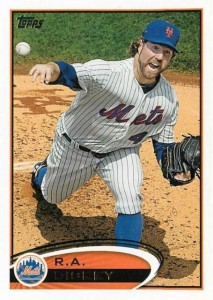 While Dickey had his one big season with the Mets (as well as a couple of other solid campaigns in New York where he pitched well but didn’t get much run support), he has not been that great with the Toronto Blue Jays in 2013-2014. He hasn’t been able to duplicate his success from that 2012 season, which kind of makes him a one-hit wonder.
Wakefield will always be highly regarded in Boston because of his longevity and his being on two World Series championship teams with the Red Sox in 2004 and 2007, but he had some very ugly seasons where he pitched poorly. In his rookie year with the Pirates, he was nearly unhittable and was a postseason star as he nearly pitched Pittsburgh into the World Series. However, over his postseason career, he was hit very hard and compiled an overall ERA of 6.75 in 18 career playoff appearances. In his final four career postseason starts, Wakefield was 0-3 with a 10.47 ERA. He especially struggled against Cleveland in the playoffs, allowing at least five runs in each of his three career postseason starts versus the Indians. Yes, he wound up winning 200 regular-season games over a 19-year career, but his ERA was over 4.00 in 15 of those seasons. He had six seasons where his ERA was over 5.00. However, he always seemed to win because of good run support with the Red Sox, as he was 14-13 with a 5.14 ERA in 1996 and 17-8 despite a 4.58 ERA two years later.
As for Tom Candiotti, he pitched 16 seasons in the big leagues, and though he finished with a career losing record and “only” 151 victories, he had an ERA over 4.00 only six times. Candiotti nearly won the ERA title in 1991, finishing with a 2.65 earned-run average that was second in the American League only to Roger Clemens (2.62). Had he allowed just one fewer earned run over the course of that season, Candiotti would have won the ERA championship. In 1993, he finished just 8-10, but suffered from atrocious run support while pitching for the Dodgers. That year, he was the ERA leader in the major leagues, pitching to a 2.43 earned-run average entering September before struggling in the season’s final weeks to finish at 3.12. In fact, for a full decade from 1986-1995, Candiotti had a 3.44 ERA, which was one of the best earned-run averages in baseball during that stretch. He also averaged 30 starts and over 200 innings during that decade, proving to be a very dependable pitcher for his clubs. He and Mark Langston were the only pitchers in the majors to work at least 200 innings in each season from 1986-1993, until the 1994 strike ended both streaks. His career ERAs after the 1995 season were 3.51 in the American League and 3.38 in the National League. Of his 151 career wins, 70 came in starts where he allowed one run or none. Even though he threw the knuckleball primarily during his career, he consistently had a 2-to-1 strikeout-to-walk ratio, meaning he consistently had twice as many strikeouts as he did walks.
Yes, R.A. Dickey was 12-1 with a 2.15 ERA at one point during the 2012 season, and Tim Wakefield started 14-1 with a 1.65 ERA in 1995. However, Candiotti had similar brilliant stretches of pitching…but not the gaudy won-loss records to show for them because the quality of his teams. In 1991, for instance, Candiotti had a 2.01 ERA in his first 19 starts…but only a 9-8 record and was left off the AL All-Star team. In 1993, he had a 1.53 ERA over a stretch of 17 starts, but was 6-1 with 10 no-decisions. The same summer when Wakefield made all the headlines in Boston with that 1.65 ERA in 1995, Candiotti had a stretch of 13 starts where his ERA was 1.74 for Los Angeles. Alas, the Dodgers gave him very little support, resulting in a 4-6 record in that stretch. Naturally, over time his accomplishments are no longer remembered.
Tom Candiotti never truly got any recognition because of the losing records he suffered while pitching for bad teams in Cleveland and Los Angeles. Had he gotten better support, he would have been better remembered. Or, if he had pitched today and gotten the same results, he would be talked about as a hard-luck pitcher because the baseball media now weigh more importance on other statistics and less on wins. During Candiotti’s time, it seemed that wins-and-losses were the be-all, end-all, and with his losing record he didn’t get as much press. Thus, he is forgotten today. On some lists on the Internet that talk about the best knuckleballers in baseball history, some bloggers cite Candiotti’s best season as 1988, when he was 14-8 with a 3.28 ERA. However, he won 15 games in 1990, nearly won the ERA championship in 1991, and from 1992-95 had the fifth-best ERA in the NL (behind only Greg Maddux, Jose Rijo, Tom Glavine, and John Smoltz). People have forgotten that he was one of the best pitchers in baseball for a while, knuckleball or not.
To learn more about Candiotti and his career, check out his biography titled Tom Candiotti: A Life of Knuckleballs, which is available on Amazon.
Why is the knuckleball such an important style of pitching in the game of baseball?
Posted by alifeofknuckleballs in Baseball, Baseball Biography, Blue Jays Baseball, Dodgers Baseball, Knuckleballs on September 5, 2014
First off, congratulations to the Vancouver Canadians and Hillsboro Hops for advancing to the Northwest League Championship Series, which begins on Saturday, September 6th. Vancouver, after finishing ahead of Tri-City for the second-half pennant and sweeping Spokane in the North Division Finals, is gunning for its fourth straight Northwest League title. Hillsboro, meanwhile, is in the finals for the first time in only its second season in the league, after the franchise relocated from Yakima, Washington.
Congratulations to both organizations.
Now, moving on to another topic…. On Quora.com, which is a Q&A website where questions are created, answered, edited, and organized by its community of users, I was recently asked the following question:
Why is the knuckleball such an important style of pitching in the game of baseball?
Here was my response on Quora:
Very few pitchers throughout the history of baseball have mastered the art of throwing the knuckleball, which is a difficult pitch to learn. It is also a difficult pitch to hit as well, as even the best hitters in the major leagues have trouble with the pitch because they are used to seeing 90-mph fastballs and the knuckler throws their timing off.

Bobby Bonilla was one of many major-leaguers who hated facing Candiotti’s knuckleball.
Tom Candiotti, a knuckleballer who pitched in the majors from 1983 to 1999, told me on several occasions that All-Stars such as Tony Gwynn, Barry Bonds, and Bobby Bonilla always told him they never liked facing him and that knuckleball because it messed up their swing for a whole week after seeing it! Bonilla, a switch-hitter, didn’t want to bat left-handed against the right-handed Candiotti, because he was afraid it would mess up his left-handed swing.
Fred Claire, a former Los Angeles Dodger general manager, also once told me that having a knuckleball pitcher as part of your starting rotation helps to give opposing hitters a different look, to take their timing off. Claire’s Dodgers in the 1990s had only right-handed starting pitchers for several years, and he mentioned having Candiotti on the staff was valuable because his knuckleball broke up the pitching pattern, so that the opposition would be seeing different pitches and different speeds during a three-game series, instead of the same 90-95 mph fastballs all the time. The knuckleball simply messes up hitters’ timing.
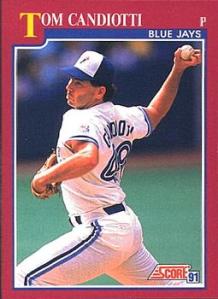 The Toronto Blue Jays thought so highly of that knuckleball too that they specifically had Candiotti start Game One of the 1991 ALCS so that he could try to mess up the Minnesota Twins hitters’ timing. So, manager Cito Gaston went with a rotation of Candiotti-Juan Guzman-Jimmy Key-Todd Stottlemyre in that series, with a soft-tossing knuckleballer going first followed by a hard thrower (Guzman), then a soft-tossing finesse pitcher (Key) and another hard thrower (Stottlemyre).
Pat Gillick, the Hall of Fame general manager who acquired Candiotti in Toronto, told me that he liked the change of pace that Candiotti brought to the Blue Jays pitching staff, because he could be put in the rotation in between a guy like Guzman and David Wells, another hard thrower.
Yes, there were other knuckleballers in the major leagues such as the Niekro brothers, Charlie Hough, Tim Wakefield, and R.A. Dickey since the 1960s. But Tom Candiotti was almost just as effective with the knuckleball. To read more about Candiotti’s career, check out Tom Candiotti: A Life of Knuckleballs, which can be found on Amazon.
No run support in milestone start…
Posted by alifeofknuckleballs in (Baseball) Life Ain't Fair..., Dodgers Baseball, Low-hit Gems, Shutouts & Scoreless Streaks on July 16, 2014
On July 12, lefty Paul Maholm got his first start in two months and pitched his best game of the season, in the Los Angeles Dodgers’ 1-0 victory over the San Diego Padres.
For Maholm, it was his first start since a 3.2-inning, 10-run disaster against the Miami Marlins on May 14, and also his 250th career major-league start. The lefty tossed six-plus shutout innings of two-hit, no-walk ball against the Padres, and the Dodgers won it in the bottom of the ninth off San Diego rookie Kevin Quackenbush [1].
Because the Dodgers couldn’t score when Maholm was still in the game, he received a no-decision to remain 1-4 on the season, though his ERA dropped from 5.18 to 4.69 [2].
Of course, Maholm hasn’t had a good season so far, with a 4.74 ERA as a starter and an equally-mediocre 4.58 earned-run average as a reliever. But hey, if you pitch into the seventh inning and give up just two hits, you deserve a win, right? Especially in a milestone appearance, such as Maholm’s 250th career big-league start.
Then again, sometimes in baseball you have certain pitchers who just don’t seem to have any luck, even when they pitch well.
I remember lefty Brian Bohanon’s 1998 season when he was acquired by the Dodgers in mid-July from the New York Mets in exchange for veteran reliever Greg McMichael. At the time, eyebrows were probably raised, because Bohanon hadn’t had a stellar career up to that point (and wouldn’t the rest of his days in the big leagues after that ’98 campaign) [3].
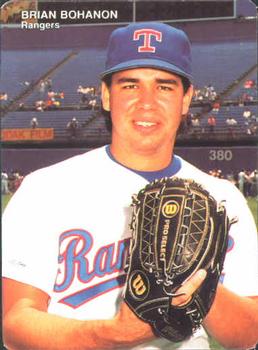 Since making his major-league debut with Texas in April of 1990, Bohanon had compiled a 5.35 ERA in his first eight seasons with four teams (Rangers, Tigers, Blue Jays, Mets). He had appeared in 178 big-league games, only 61 of them starts. In 1994, his last season with the Rangers, his ERA was 7.23. The following year, in his lone season with Detroit, it was 5.54. Then a 7.77 ERA for Toronto in 1996 in 20 appearances, all in relief.
Yet, with the Dodgers in 1998 following the trade with the Mets, Bohanon was immediately inserted into the starting rotation, and the veteran lefty somehow delivered. He logged a 2.40 ERA in 14 starts, tossing two complete games. In 97.1 innings, he allowed only 74 hits and struck out 72 batters.
The problem? The Dodgers couldn’t score for him. As a result, Bohanon was only 5-7 with the Dodgers. Also, as mentioned above, he tossed two complete games with Los Angeles – but he lost both games. On September 11, Bohanon pitched eight innings of seven-hit ball with eight strikeouts in San Diego, but the Dodgers lost 1-0 to Padres righty Joey Hamilton. In his final appearance of the season – and as it turned out, his final game with the Dodgers – he gave up only three runs over his nine innings of work, but lost a 3-2 decision to San Diego right-hander Andy Ashby.
Following the season, he joined the Colorado Rockies, where he would pitch his final three major-league seasons. Though he won 29 games for the Rockies, he also lost 30 and pitched to a 5.82 ERA with Colorado.
But a 5-7 record even with a 2.40 ERA for the Dodgers? That’s pitching in hard luck.
There’s also lefty Odalis Perez – who like Maholm also used to pitch for the Braves. Sure, Perez was mediocre toward the end of his career. But he also won 15 games for the Dodgers in 2002, his first season in Los Angeles. Two years later, he logged a 3.25 ERA in 31 starts, but managed just a 7-6 record as the Dodgers scored two runs or fewer for him 10 times.
Ismael Valdez won 15 games in 1996 with the Dodgers, but the following year was only 10-11 despite a 2.65 ERA in 30 starts. For the 1997 season, he received only 3.38 runs of support [4].
Then there was Tom Candiotti, who on June 16, 1995, made his 300th career major-league start and pitched eight shutout innings of three-hit ball at Wrigley Field. He also took a no-hitter into the sixth in his matchup against Cubs right-hander Steve Trachsel, who at that point in his career was known for his inability to win at home. Alas, the Dodgers couldn’t score at all, and Howard Johnson’s two-run homer in the bottom of the ninth off Rudy Seanez won it 2-0 for the Cubs.
A no-decision for Candiotti despite pitching shutout ball in a milestone start – much like Paul Maholm back on July 12 this year. And that was the type of season for Candiotti, who despite a 3.50 ERA went 7-14.
Sometimes that’s how things are in baseball. Some pitchers are just plain unlucky. Paul Maholm surely knows the feeling.
—————————————————————————-
[1] The Dodgers would beat the Padres by the same 1-0 score the following afternoon to take three of four in the series.
[2] His mound opponent, right-hander Ian Kennedy, pitched eight shutout innings of three-hit ball.
[3] Another interesting part of the deal was that McMichael began the season with the Mets and was traded in early June to Los Angeles with Dave Mlicki for former Atlanta teammate Brad Clontz as well as Hideo Nomo. Just a month later, McMichael was sent back to the Mets for Bohanon. Mlicki, by the way, was 7-3 with the Dodgers despite a 4.05 ERA in his 20 starts. Probably best known for tossing a shutout in 1997 in the first-ever interleague regular-season game between the Mets and Yankees, Mlicki did throw a complete-game shutout in Colorado while with the Dodgers in ’98, though.
[4] It should be noted, though, that three of his losses came during a stretch from May 31 to June 20, when he really struggled. In that five-start span, Valdez was 0-3 with a 6.41 ERA, with the Dodgers losing four of those games. On June 20, he was chased after only 5.1 innings despite being staked to a huge 7-0 lead against the Giants, a game which the Dodgers eventually won in extra innings.
Sometimes zeroes don’t mean much…
Posted by alifeofknuckleballs in (Baseball) Life Ain't Fair..., Blue Jays Baseball, Dodgers Baseball, Impressive Debuts, Indians Baseball, Low-hit Gems on July 12, 2014
Dan Johnson, called up by the Blue Jays from Triple-A Buffalo on July 11, made his Toronto debut that same night against his old team, the Tampa Bay Rays, and had the most interesting stat line in his new club’s 8-5 victory.
Johnson, probably best known for his ninth-inning homer for Tampa Bay against the Red Sox in September of 2008 in a contest which gave the Rays the AL East lead and then another dinger against the Yankees in the 2011 season finale to help the Rays clinch the wild card, posted the following line in his Toronto debut:
0 AB, 3 R, 0 H, 0 RBI, 4 BB, 0 SO.
Though Johnson couldn’t get a hit, he still made a huge contribution for Toronto. The Blue Jays’ newest DH was still was able to reach base in all four plate appearances and, more importantly, came around to score three times – including the tie-breaking run in the ninth inning after he had drawn a leadoff walk against the struggling Grant Balfour.
Definitely an odd and crooked-looking line score.
This reminds me of a couple of weird-looking stat lines for Tom Candiotti, where he lost a couple of games despite allowing zero earned runs. Same with John Smoltz, who lost a pivotal game to the Philadelphia Phillies in Game Four of the 1993 NLCS.
Let’s start with the Smoltz game, with the Atlanta right-hander owning a career postseason record of 5-0 with a 2.13 ERA in nine starts heading into the October 10, 1993 contest against lefty Danny Jackson (a playoff veteran himself) and the Phillies. Thanks to a Mark Lemke error at second base in the fourth inning, the Phillies scored two runs off Smoltz to take a 2-1 lead. The Braves almost tied it in the eighth when they put two runners on with two outs and erratic closer Mitch “The Wild Thing” Williams took over for Jackson.
Lemke, looking to redeem himself for the earlier fielding error, took Williams’s second pitch to deep left – which would have tied the game but leftfielder Milt Thompson made a circus catch to end the inning.
Atlanta then put two runners on to lead off the ninth but Williams fielded Jeff Blauser’s sacrifice bunt attempt and threw out the lead runner at third base, before inducing Ron Gant – arguably the league’s best clutch hitter down the stretch – to hit into a game-ending double play. The Phillies won 2-1 to even the series at 2-2, and then won the next two games to clinch the NL pennant.
But here was Smoltz’s line in the game:
6.1 IP, 8 H, 2 R, 0 ER, 5 BB, 10 SO.
It was Smoltz’s first career postseason loss – despite the fact he struck out 10 Phillies and gave up zero earned runs. What was interesting too, was that reliever Mark Wohlers walked three and struck out five in two hitless innings, meaning Atlanta pitching struck out 15 Philadelphia hitters but the Phillies still prevailed [1].
 Then, on to Tom Candiotti. On August 3, 1990, the Cleveland Indians knuckleballer took a no-hitter into the bottom of the eighth inning at Yankee Stadium. He retired the first two batters and was four outs away from history, with a 4-2 lead. The Yankees had scored two runs in the first inning on a hit batsman, an error by second baseman Jerry Browne, a Candiotti wild pitch, and an RBI groundout by Mel Hall.
With two outs in the eighth, Steve Sax walked before Jim Leyritz reached on an error by shortstop Felix Fermin. Yankees rookie Oscar Azocar, in his first month in the majors, broke up the no-hitter with a single up the middle, cutting the deficit to 4-3.
At that juncture, Indians skipper John McNamara pulled Candiotti in favor of closer Doug Jones, who gave up a first-pitch home run to Hall, turning the 4-3 lead into a 6-4 deficit. That was the way the game ended, with Candiotti charged with the loss and the following line:
7.2 IP, 1 H, 5 R, 0 ER, 2 BB, 7 SO.
All five runs off Candiotti were unearned because of the fielding errors by Browne and Fermin.
Then on June 30, 1995, Candiotti was pitching for the Dodgers against the Colorado Rockies, and gave up two first-inning runs because of an error by third baseman Tim Wallach. At the time, the two runs seemed insignificant because Rockies starter Kevin Ritz was just 11-24 with a 5.78 ERA going into the season, and you would figure a lineup featuring Mike Piazza, Eric Karros, and Raul Mondesi would do some damage against a mediocre pitcher.
Unfortunately, the Dodgers couldn’t touch Ritz, who gave up just three hits over six shutout innings (though he also walked five and struck out only one). Karros finally homered off Curtis Leskanic in the ninth to break the shutout, but the Dodgers couldn’t get the tying run home in the 2-1 loss.
The line for Candiotti:
7 IP, 4 H, 2 R, 0 ER, 2 BB, 7 SO.
It was as good a start as Candiotti had had at Yankee Stadium five years earlier – but again only good enough for a loss. It would be that type of a season for the knuckleballer, who went 7-14 despite a respectable 3.50 ERA for a first-place Dodger team [2].
Funny stat lines – they happen in baseball from time to time, and thanks to Dan Johnson for reminding me of these couple of examples.
—————————————————————————————–
[1] Kent Mercker, who also appeared in the game for the Braves, recorded two outs but did not issue a walk or notch a strikeout.
[2] Teammate Ramon Martinez was 17-7 with a 3.66 ERA.
Dominant streaks: Clemens, Johnson, Pedro… and who?
Posted by alifeofknuckleballs in Dodgers Baseball, Low-hit Gems on July 5, 2014
Back on June 29, Seattle Mariners ace right-hander Felix Hernandez allowed only one hit over eight shutout innings to defeat the visiting Cleveland Indians 3-0, giving up just Lonnie Chisenhall’s fifth-inning single.
For Hernandez, who walked three, it was his ninth consecutive start where he had pitched at least seven innings while giving up two runs or fewer. During that stretch, Hernandez was 6-1 with a 1.30 ERA with 77 strikeouts and just 10 walks over 69 innings. In those nine outings, he surrendered a total of 42 hits and one homer.
The nine consecutive starts with seven or more innings with two or fewer runs is a Mariners club record, and in fact is a rare feat in baseball. According to Baseball-Reference.com, Tom Seaver holds the longest such streak in big-league history, going 13 straight starts in 1971 where he allowed two runs or fewer while working at least seven innings.
From 2001-2013, only six pitchers had such a streak of at least eight consecutive starts, which shows how rare Hernandez’s feat has been.
 As for the 1990s? Well, only five pitchers in that decade had a stretch of eight straight starts where they gave up only two runs or fewer while pitching at least seven innings. The list includes fireballers Roger Clemens, Randy Johnson, and Pedro Martinez. You would expect to see those names, as Clemens, Johnson, and Martinez were three of the most dominant pitchers in the 1990s, as well as in baseball history. Surprisingly, Ed Whitson accomplished this feat during the 1990 season, when he went 5-0 with a 0.99 ERA in those eight consecutive starts from July 25 to September 2 for the San Diego Padres. During his streak, Whitson walked just eight batters in 63.1 innings.
Who was the fifth pitcher to accomplish that rare feat in the 1990s with eight consecutive such starts? No, not Greg Maddux [1]. Not Tom Glavine or John Smoltz. Not Mike Mussina.
Nope. The fifth guy who did it was Los Angeles Dodgers knuckleballer Tom Candiotti, who accomplished the feat in 1993.
During a season which saw the Dodgers finish 81-81, the highlights were rookie Mike Piazza’s monster season and the team’s 12-1 rout over the Giants on the final day of the year to knock San Francisco out of the postseason.
But there was also the overlooked Candiotti and his pitching throughout the summer, as he had a 1.85 ERA in 22 starts from May 1 to the end of August. Entering play on September 1, Candiotti’s 2.43 ERA was the best in the major leagues, marking the second time in three years that he had the ERA lead at one point in the final weeks of the season.
The knuckleballer’s streak of eight straight starts with two or fewer runs and seven or more innings took place from July 18 to August 25, when he pitched to a 1.32 ERA over 61.1 innings while allowing only 17 walks and four home runs. Included in that streak was a 2-1 win on July 28 in San Francisco, where he held Giants sluggers Will Clark, Matt Williams, and Barry Bonds to one hit in 10 at-bats.
Candiotti went only 5-0 in that streak because he didn’t get enough support in the other three starts. On August 9, he gave up two runs over eight frames but the Dodgers lost 3-2 in 11 innings against Colorado. (The Dodgers couldn’t touch Rockies right-hander Greg Harris, who would be 4-20 with a 6.60 ERA in a Colorado uniform in 1993-94.) On August 20 in St. Louis, Candiotti allowed two runs over seven innings but left the game trailing 2-0 against rookie Rene Arocha, before the Dodgers rallied for three runs in the ninth to spare him a heart-breaking loss. Five nights later, he gave up one run on four hits over eight innings against Pittsburgh, only to leave the game trailing 1-0 to Pirates rookie Paul Wagner. The Dodgers tied it in the bottom of the eighth but ultimately lost 2-1 in 12 innings.
That performance in that last outing on August 25 lowered Candiotti’s ERA to 2.43, tops in all of baseball.
Certainly, when you think about long stretches of dominant pitching, you think of guys such as Felix Hernandez, Roger Clemens, Randy Johnson, and Pedro Martinez. Ed Whitson? Well, at least he threw a fastball.
Tom Candiotti, a guy who threw a knuckleball? You would have never figured he had had such a long run of great pitching. But it happened. Back in that underrated 1993 season.
[1] Even in Maddux’s dominant 1994-95 seasons, when he had sub-2.00 ERAs of 1.56 and 1.63, respectively, he didn’t have that many starts in a row with seven or more innings with two or fewer runs allowed. The longest streak he had in those seasons lasted “only” a half-dozen. Maddux had six consecutive such starts in 1994, and again six straight in 1995.
-
You are currently browsing the archives for the Dodgers Baseball category.
Buy from Amazon.com

Buy from Barnes & Noble

The 1988 Dodgers
Tom Candiotti: A Life of Knuckleballs

Flag Stats
 A Life of Knuckleballs